

Kratom Drug Test for Work or Court: Get LC MS/MS Confirmation
29 August 2026

Whether kratom shows up on a drug test depends entirely on which panel is used. Routine workplace 5 or 10-panel screens almost never include kratom, so most users won’t trigger a positive result. But if a laboratory specifically runs a targeted assay for mitragynine using LC-MS/MS or LC-HRMS, it will detect it reliably. If detection accuracy genuinely matters to you, ask the testing provider for a kratom-specific assay with confirmatory mass spectrometry.
TL;DR:
- Standard drug tests rarely include kratom unless a specific assay for mitragynine is ordered, especially one using LC-MS/MS or LC-HRMS.
- At-home immunoassay strips and dip cards can detect kratom metabolites but are prone to false positives and are not definitive without laboratory confirmation.
- Confirmatory testing with LC-MS/MS provides more accurate, legally defensible results, especially at lower cutoff levels around a few nanograms per milliliter.
- Kratom typically clears from urine within a few days for occasional users but can be detectable for over a week with regular, concentrated use.
- Requesting a targeted mitragynine test with proper chromatography and mass spectrometry validation is essential for reliable detection in legal, clinical, or employment scenarios.
Table of Contents
- Which tests can detect kratom in urine?
- How urine kratom tests work: cutoffs, sensitivity and confirmatory results
- How long does kratom stay in your system?
- Are home kratom test kits reliable enough to trust?
- How do you request a kratom-specific urine test?
- What Kratome’s batch lab reports reveal about detectability
- What matters most when you’re worried about a kratom drug test
- Which Kratome strains come with lab-verified alkaloid data?
- Sources
Which tests can detect kratom in urine?
Standard drug panels screen for opioids, amphetamines, THC, cocaine, and PCP. Kratom’s active alkaloid, mitragynine, isn’t on that list. This is why most people who use kratom regularly never see it flagged on a typical pre-employment or workplace test.
That doesn’t mean kratom is invisible to testing. It just means you need the right test.
Immunoassay strips and dip cards work by detecting antibodies that bind to a target compound above a set concentration. Several manufacturers now sell kratom-specific dip cards and test strips, some claiming results in five minutes using a cutoff concentration in the low hundreds of ng/mL range, such as the ALLTEST kratom urine strips. These are aimed at treatment programmes and probation officers who need a quick preliminary answer, not definitive legal proof.
Several test types exist beyond the basic strip:
- Single-analyte dip cards built specifically to flag mitragynine, often marketed to addiction treatment centres.
- Multi-panel point-of-care cups that bundle a kratom assay alongside opioids, benzodiazepines, and other common targets, popular in probation and workplace settings that want broader coverage in one device.
- Clinical laboratory quantitative tests, which use LC-MS/MS to measure exact mitragynine concentrations rather than a simple yes/no readout.
Major reference laboratories confirm that kratom sits outside their standard panels by default. Quest Diagnostics lists mitragynine as a specialised monitoring test that clinicians must order separately, not something that appears automatically. Pain management clinics use this most often, checking that patients aren’t combining kratom with prescribed opioids in ways that complicate treatment. Forensic labs and probation programmes are the other main requesters, usually because a specific policy or court order names kratom explicitly.
How urine kratom tests work: cutoffs, sensitivity and confirmatory results
Every urine test for kratom works in two possible stages: screening and confirmation. Screening with immunoassay gives a fast preliminary result. Confirmation with mass spectrometry gives a legally and clinically defensible one.
The distinction matters because immunoassays are prone to cross-reactivity. Research presented in a conference abstract on kratom cross-reactivity found that kratom metabolites can trigger false positives in immunoassay panels designed for other drug classes, including methadone in some screening kits. A positive screen is a signal to investigate further, not a verdict.
Statistic to know: Clinical laboratories such as Drexel Medicine Diagnostics report turnaround times where 90% of quantitative mitragynine results return in under 48 hours, and half return within 24 hours.
Cutoff levels vary by method and lab, typically expressed in nanograms per millilitre (ng/mL). At-home strips often set their cutoff around 300 ng/mL, a threshold chosen for speed and simplicity rather than precision. Clinical LC-MS/MS methods work at far lower concentrations, sometimes down to low single-digit ng/mL, which is why they catch trace exposure that a strip would miss entirely.
What separates a reliable result from a disputable one usually comes down to three things:
- Whether the lab used chromatographic separation to isolate individual alkaloid diastereomers, rather than reporting one merged peak.
- Whether mass spectrometry confirmed the specific compound detected, ruling out cross-reacting substances.
- Whether the reported cutoff and units are documented clearly enough to interpret the number correctly.
A study on mitragynine diastereomer separation found that routine multi-analyte methods sometimes merge mitragynine with its structurally similar cousins into a single signal. An improved LC-HRMS method separated all four diastereomers and confirmed them individually across 29 patient urine samples, achieving that separation within five minutes and detecting concentrations as low as 1 μg/L during validation.
How long does kratom stay in your system?
Most occasional users clear mitragynine from urine within a few days. Heavier, more frequent users may test positive for about a week or more after their last dose.
Mitragynine has a reported elimination half-life in the range typically cited for moderate-dose oral compounds, meaning repeated dosing builds up a longer clearance tail than a single dose would. Several factors shift that window meaningfully:
- Dose and frequency: someone taking small amounts occasionally clears kratom faster than a daily user taking multiple doses.
- Product potency: concentrated extracts, including those higher in 7-hydroxymitragynine, tend to produce higher peak concentrations and can extend detectability.
- Body composition: alkaloids can accumulate in fatty tissue, so body fat percentage influences how long traces linger.
- Liver and kidney function: mitragynine is metabolised primarily by the liver and excreted via the kidneys, so impaired function in either organ slows clearance.
- Hydration and metabolism: faster metabolic rate and consistent hydration generally support quicker elimination, though this varies person to person.
If you’re planning around a test date, treat the longer end of these ranges as your working assumption rather than the average. A single low dose taken days ago is a very different scenario to daily use of a potent extract, and the safest planning always assumes your body clears things more slowly than you’d like.
Are home kratom test kits reliable enough to trust?
Home kits and point-of-care cups serve a purpose, but they’re built for speed, not certainty. Understanding their limitations before you rely on one saves you from a result you can’t actually defend.
- Check the claimed cutoff. A product listing should state its sensitivity threshold in ng/mL. Products with vague or absent specifications, such as some dip card kits sold on general marketplaces, deserve extra scrutiny before you trust the result.
- Understand the narrower analyte range. Most home strips target mitragynine alone, missing related alkaloids that a full lab panel would separately identify.
- Account for user error. Dip cards and cups are sensitive to timing, storage temperature, and how the strip is read, all of which can shift results either direction.
- Know when adulteration risk rises. Diluted or tampered samples can produce false negatives on immunoassay strips that a lab’s validity checks would otherwise catch.
Pro Tip: If a result carries legal, employment, or medical consequences, treat a home kit result as a starting point only, and request laboratory confirmation before acting on it.
Lab confirmation changes the legal and clinical weight of a result entirely. A confirmed LC-MS/MS reading with a documented cutoff and method is defensible in a hearing or clinical file; a strip result on its own generally isn’t.
How do you request a kratom-specific urine test?
Getting the right test ordered means using precise language, because “kratom test” alone can mean five different things to five different labs.
Ask specifically for mitragynine and 7-hydroxymitragynine screening with LC-MS/MS confirmation. That phrase tells the provider you want both the parent alkaloid and its more potent metabolite covered, with mass spectrometry backing up any positive screen.
Before agreeing to a test, confirm these details in writing:
- Which analytes are included, and whether 7-hydroxymitragynine is covered separately from mitragynine.
- The screening cutoff and reporting unit (almost always ng/mL).
- The confirmatory method used if the screen comes back positive.
- Expected turnaround time and required specimen volume.
- Whether chain-of-custody documentation is needed, relevant for probation or forensic contexts.
Pro Tip: Request the lab’s certificate of analysis or a written method summary alongside your result. It’s the single easiest way to confirm the number you’ve been given actually means what you think it means.
What Kratome’s batch lab reports reveal about detectability
Every batch Kratome sells goes through independent laboratory testing before it reaches a customer, checking both the alkaloid profile and contaminant levels. That data matters directly for anyone thinking about testing outcomes, not just product quality.
The alkaloid profile in a given batch, including the balance between mitragynine and 7-hydroxymitragynine, determines which diastereomers show up in urine and in what proportion. This is exactly the variable that specialised lab methods like LC-HRMS are built to resolve.
Reading a batch report gives you:
- The measured mitragynine concentration per gram, useful context if you’re trying to gauge relative dosing.
- Contaminant screening results, ruling out adulterants that could complicate an unrelated test.
- Batch and harvest traceability, so you know exactly what you consumed if a question ever arises.
Kratome publishes these reports openly on its kratom lab reports page for anyone who wants the raw data rather than a summary.
What matters most when you’re worried about a kratom drug test
The conventional advice on this topic tends to stop at “kratom isn’t tested for,” which is true but incomplete, and increasingly outdated as more treatment programmes and forensic labs add it to their standard requests. That framing gives people false confidence right up until a probation officer or a pain clinic orders the one assay that does catch it.
What the evidence actually supports is narrower and more useful: the outcome depends almost entirely on whether the testing party has requested a targeted mitragynine assay, and whether that lab separates diastereomers properly rather than reporting a merged, ambiguous peak. A result built on sloppy chromatography is not a result you can rely on, whichever direction it points.
If there’s one thing readers should prioritise, it’s asking the right question before the sample is ever collected, not after. Find out whether the test in front of you is a routine panel or a kratom-specific one, and if certainty matters, insist on LC-MS/MS confirmation rather than trusting a strip alone. That single habit does more for accuracy than any amount of worrying about detection windows.
— Juridic
Which Kratome strains come with lab-verified alkaloid data?
If consistency matters to you, whether for peace of mind around testing or simply knowing what you’re taking, Kratome’s lab-tested strains give you a documented starting point rather than a guess.
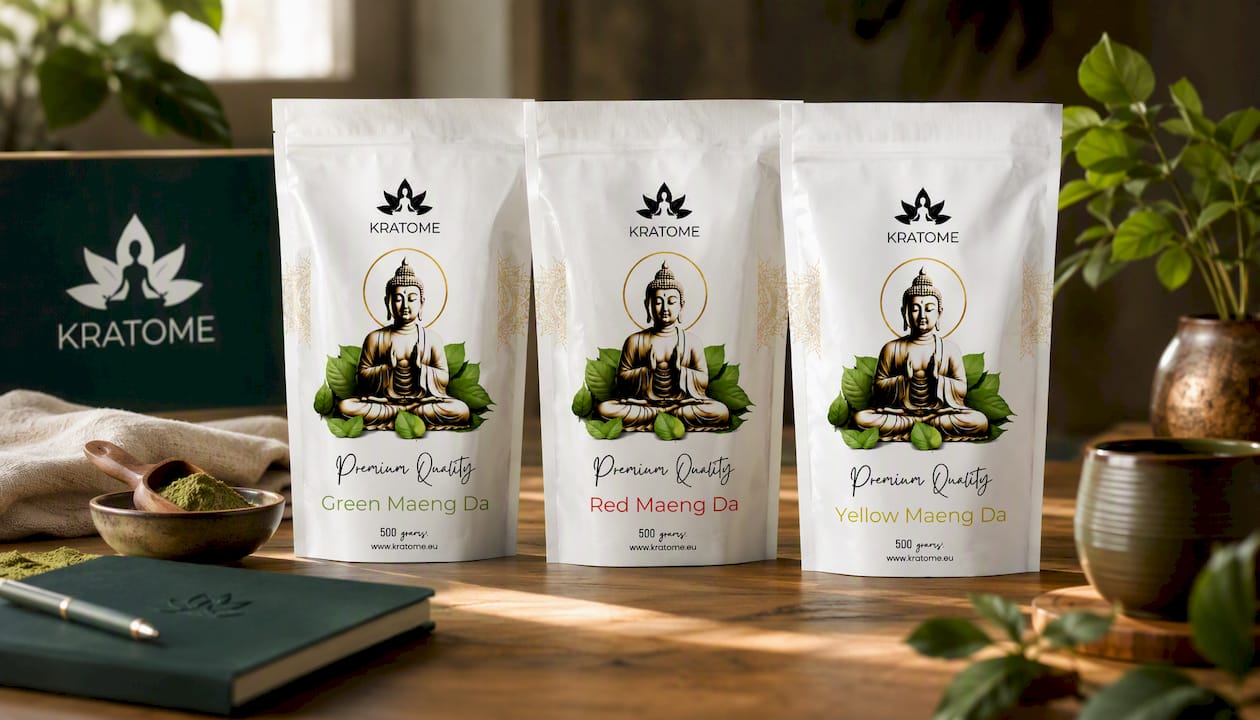
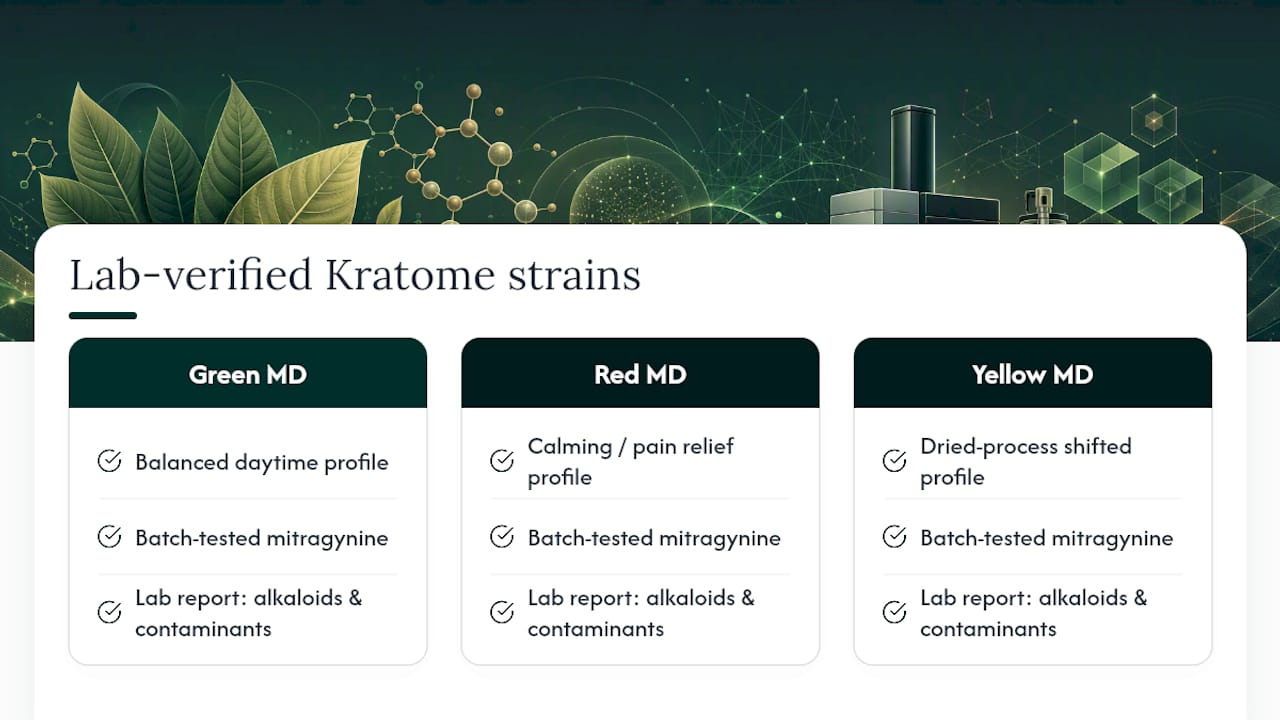
Green Maeng Da offers a balanced alkaloid profile suited to steady daytime use, with each batch’s mitragynine content confirmed before it ships. Red Maeng Da leans toward a more calming profile, popular among customers focused on relaxation or pain relief, and carries the same batch-level verification. Yellow Maeng Da takes a distinct drying process that shifts its alkaloid balance again, giving customers a third clearly documented option rather than an unverified blend.
Every batch report shows the measured alkaloid concentration and contaminant screening results, so if workplace or clinical testing is a concern, you can check exactly what’s in the product you’re consuming rather than relying on marketing claims. Kratome ships across the EU and UK, with customer support on hand if you have questions about a specific batch. Browse the Green Maeng Da, Red Maeng Da, and Yellow Maeng Da product pages, and check the linked lab report for each batch before you order.
Sources
Technical claims in this article draw on peer-reviewed analytical chemistry research into mitragynine diastereomer separation, clinical laboratory specimen and cutoff guidance from Drexel Medicine Diagnostics and Quest Diagnostics, and product listings for at-home kits such as ALLTEST’s kratom strips, included for comparison only.
This article is general information, not a substitute for advice from a qualified doctor. Consult a qualified healthcare professional about your own circumstances before acting on anything here.
- Drug testing for mitragynine and kratom: Analytical challenges and medico‑legal considerations
- Mitragynine (Kratom), Urine, Quantitative Testing Services at Drexel Medicine Diagnostics Laboratory | Drexel Medicine
- Drug Monitoring, Mitragynine, Quantitative, Urine — Quest Diagnostics test directory
- Abstract: Kratom cross‑reactivity in immunoassay screens (conference abstract)
- ALLTEST Kratom Urine Drug Test Strips KRA300
